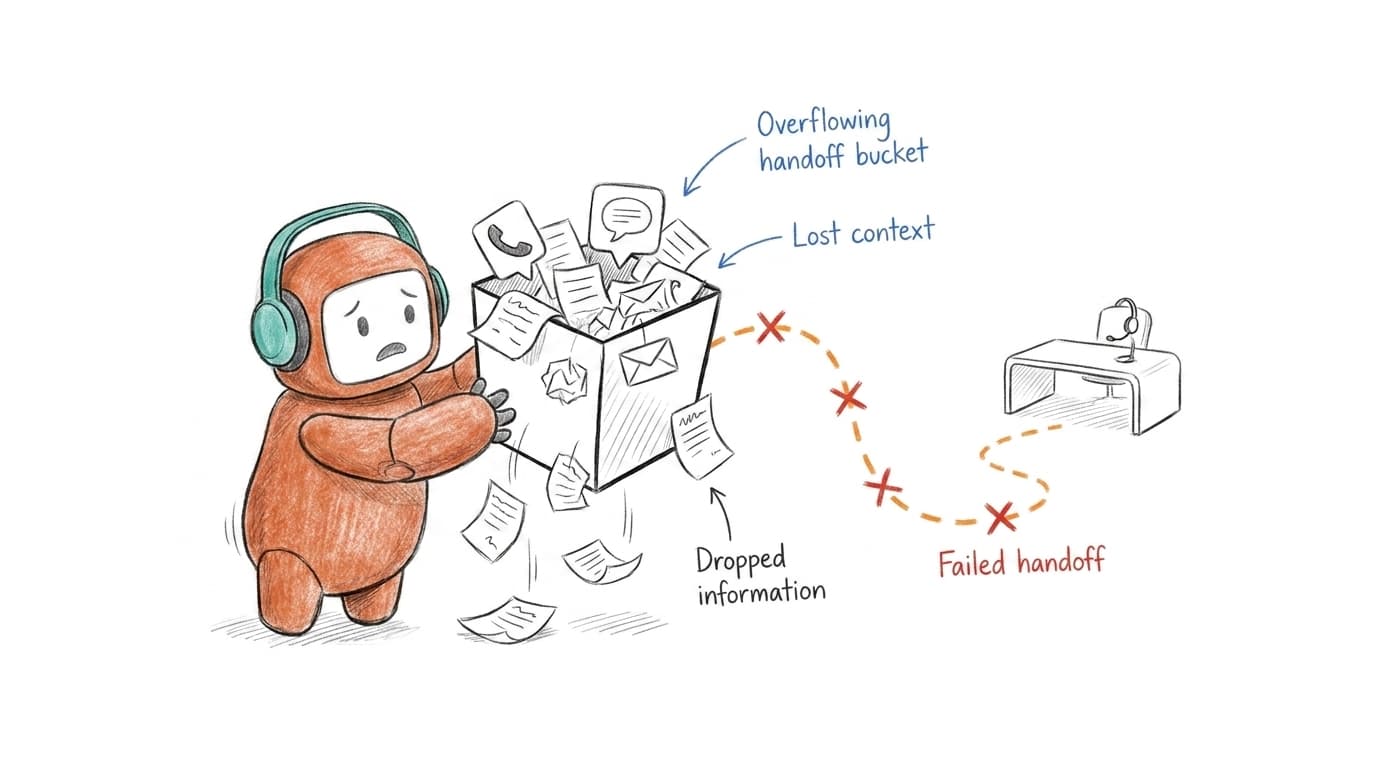
Your customer has already explained the billing error twice before the call reaches a specialist. The specialist opens a blank case and asks for the account number again. Customer service handoff mistakes start in that gap, where the conversation moves but the facts stay behind. Customers don't care which system dropped the thread. They remember being forced to start over.
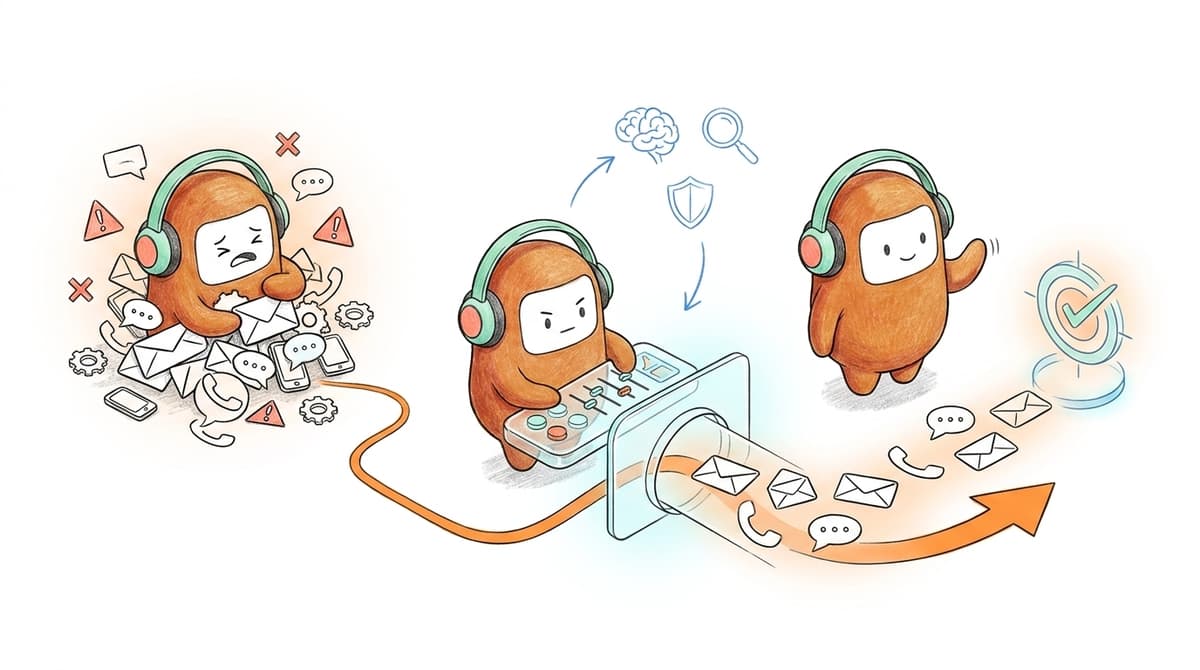
Most customer service handoff mistakes aren't caused by an agent forgetting to read the notes. They happen because chat, voice, ticketing, and routing operate as separate systems. Context has to cross tool boundaries, queue rules have to agree, and someone must accept ownership. If any part breaks, the customer becomes the integration layer.
Key Takeaways:
- Treat every handoff as a transfer of context and ownership, not just a change of agent.
- Diagnose handoff failures across the full workflow before changing scripts or prompts.
- Define exact escalation triggers, receiving queues, and fallback owners for every channel.
- Pass a structured transfer packet containing the customer's intent, history, actions taken, and unresolved need.
- Measure whether customers repeat themselves, bounce between queues, or wait after escalation.
- Keep AI and human agents inside one operating layer when channel continuity matters.
Why Customer Service Handoffs Break Across Channels

The Customer Becomes the Missing Integration
At 10:40 a.m., a support manager opens the chat console, the CRM, and the phone queue to investigate one complaint. The customer entered an account number in chat, answered two verification questions, and asked for a person. The phone agent received the call with none of that attached. Five minutes later, the customer is repeating information the company already collected, and the manager is watching it happen across three screens without a way to stop it.
The handoff mistake looks small from inside each tool. Chat completed its escalation rule, telephony accepted the transfer, and the agent followed the verification script. Nobody sees a broken system because every component reports success. From the customer's side, the company has forgotten the conversation halfway through it.
Technical Transfers Can Still Fail Operationally
A transfer can succeed technically and still fail operationally. Sending a conversation to another queue proves only that the routing action fired. It doesn't prove the context arrived, the new owner accepted the work, or the customer knew what would happen next. Those are the parts that matter.
The common mistake is testing the transfer event instead of the complete handoff. Operations confirms the button works, engineering confirms the API returned a successful response, and support confirms the ticket appeared. Nobody checks whether the receiving agent can continue without restarting discovery. A proper review follows four separate conditions:
- The trigger matched: The system escalated for the intended reason.
- The destination was correct: The conversation reached an agent with the right skill and availability.
- The context arrived: Prior messages, customer details, and completed actions remained visible.
- Ownership changed: A named queue or person became responsible for the next response.
Miss any one of the four and the transfer log still reads green while the customer starts over.
Fragmented Ownership Creates Repeat Work
Chat and voice can each work well while the handoff between them stays broken. Separate tools often carry separate customer IDs, queue logic, permissions, and reporting. One system treats the interaction as closed while another opens a fresh case, and the handoff mistake grows inside that gap.
Point tools have real merits. A small support team with one channel and low volume may be better served by a focused helpdesk than a broader customer operations platform. Once customers move between chat, SMS, voice, and human support, the integration cost changes the math. Each new boundary is another place where context can drop.
A good handoff record works like a bank statement. Every action is visible, ordered, and tied to the same customer, so the next person sees what changed without reconstructing it from several screens. Without that record, your agents spend the first part of every escalation doing digital archaeology, digging through timestamps to rebuild a story the customer already told.
The visible problem is repetition. The deeper problem is that no shared operating layer owns the conversation from the first message to final resolution. If you can only fix one thing, fix ownership before you touch a single script.
How to Prevent Customer Service Handoff Mistakes
Preventing customer service handoff mistakes requires one complete workflow, from the first customer message through human acceptance. Start by auditing where context disappears, then define escalation rules and the information every receiving agent needs. Test channel changes as real customer journeys, not isolated routing events.
Diagnose the Full Handoff Before Changing Prompts
Can your team explain exactly what happens between an escalation trigger and the first human response? If the answer changes depending on who you ask, the workflow isn't documented well enough. Support understands the queue, engineering understands the integration, and the AI team understands the trigger. The customer crosses all three, and nobody owns the whole path.
Pull ten recent escalations from one workflow. Follow each conversation from the original channel into the human queue, checking what the customer shared against what the agent received. Don't start by editing AI instructions. If the context never reached the destination, a better prompt won't fix the handoff.
Use these questions during the review:
- Can the receiving agent see the full conversation without opening another system?
- Does the record state why the escalation happened?
- Are completed verification or troubleshooting steps visible?
- Is one queue or person responsible after the transfer?
- Can the customer tell that a handoff is happening and what comes next?
If two or more answers are no, fix the workflow before tuning tone or response wording. Handoff failures are often architecture problems wearing a conversation-design costume.
Separate the Escalation Trigger From the Destination
A good trigger identifies why AI should stop. A good destination decides who takes over based on skill, capacity, channel, and operating hours. Combine both decisions into one broad rule and you get wrong transfers. "Send complex cases to support" isn't enough.
Define triggers around observable conditions rather than vague labels. An unresolved intent after a set number of attempts is observable. A customer request for a person is observable. A policy exception, a negative sentiment signal, or a required approval can also be configured. The destination rule then chooses where the conversation goes and what happens if nobody accepts it.
Document the routing sequence in order:
- Identify the escalation condition: State the exact event that stops automation.
- Select the receiving queue: Match the case to the required skill and available channel.
- Set an acceptance deadline: Decide when the workflow should invoke its fallback.
- Define the fallback owner: Route unanswered cases somewhere specific rather than leaving them unassigned.
Some teams prefer one general escalation queue because it's easier to manage. That's valid when volume is low and agents share the same skills. Once specialist queues appear, a general queue becomes a sorting desk that adds another handoff before any work begins, which is the exact mistake you set out to remove.
Pass Five Fields With Every Transfer
Five fields cover most of what a receiving agent needs: customer identity, intent, conversation summary, actions already taken, and the unresolved request. The exact format can differ by workflow, but none of these fields should depend on the agent reading a raw transcript from the top. Transcripts are evidence, not summaries.
Having the full history is useful, yet more data doesn't always create more clarity. A 40-message transcript can bury the one sentence that explains why the customer needs a person. The transfer packet should lead with the current state, then keep the detailed record underneath. In my view, forcing agents to read everything again is only a better-documented version of asking the customer to repeat it.
Every handoff should include:
- Identity: The matched customer record and relevant account context.
- Intent: What the customer is trying to complete.
- Summary: A short account of the conversation so far.
- Actions: Checks, answers, or workflow steps already completed.
- Open need: The exact question, exception, or decision still requiring a person.
Preserve One Thread Across Channel Changes
A US property-data company needed outbound lead engagement tied directly to its sales process. Treating the initial engagement and the sales follow-up as separate workflows would have left reps rebuilding lead history before every conversation. The design choice that mattered was continuity: engagement had to connect to the next action rather than ending when automation finished.
The same rule applies to support. A customer who starts in web chat and moves to voice hasn't started a new journey. The channel changed, but the identity, intent, prior answers, and expected outcome did not. Before the change, the phone agent sees a new caller. After proper thread matching, the agent sees an active case with work already completed.
Channel continuity does require integration work, and pretending otherwise creates bad deployments. Phone numbers may not match account records, shared inboxes may hold several users, and customers sometimes switch devices mid-issue. Those exceptions need identity rules and a fallback path. The goal isn't perfect matching in every case; it's a clear process for handling uncertainty without making the customer carry it.
If your current workflow loses the thread at that exact channel change, book a demo to map the trigger, transfer packet, and receiving queue against one live case. The review should show where identity or ownership breaks. From there, the required workflow becomes much easier to define.
Test Edge Cases Before Launch
Happy-path testing hides the handoff failures customers actually remember. A clean test account with one open ticket and one available agent proves very little. Production brings duplicate records, closed queues, unsupported requests, interrupted calls, and customers who ask for a person immediately. Those cases expose whether the workflow has real recovery logic or just a working button.
Testing should involve operations, frontline agents, and the technical owner responsible for data movement. Each group catches a different failure. Operations notices a policy gap, agents notice missing context, and technical owners notice records that don't map correctly. We were surprised by how often the handoff itself worked while the fallback path had never been defined at all.
Run these scenarios before approving the workflow:
- The customer asks for a human before answering any questions.
- The correct queue is closed or has no available agent.
- The customer changes from chat to voice midway through the issue.
- The customer record has duplicate or conflicting identifiers.
- The human agent rejects or reassigns the conversation.
- The channel disconnects after escalation but before acceptance.
A recommended process with this much testing has a real downside: launch takes longer. That's a fair trade when the alternative is finding ownership gaps through customer complaints. For a low-risk FAQ flow, lighter testing may be enough. Billing, collections, account access, and high-value lead workflows deserve the full review.
Measure Recovery, Not Just Transfer Volume
What should you measure after launch? Track whether the customer reaches the right person with enough context to continue. Transfer counts and escalation rates show volume, but they don't tell you whether the handoff worked. A rising transfer rate could mean sharper escalation judgment or a failing AI workflow, and the number alone won't say which.
Review at least 20 handoffs from each major workflow after any routing change. Read or listen from the customer's first message through the human response. If customers repeat details, wait after the transfer, or get moved again, the workflow still has a context or ownership gap. Numbers should lead you back to the conversation, not replace it.
Four measures reveal the condition of the handoff:
- Repeated information: How often customers restate details already provided.
- Time to human acceptance: How long the case waits after escalation begins.
- Second-transfer frequency: How often the first receiving queue sends it elsewhere.
- Continuation quality: Whether the human response uses the existing context or restarts discovery.
If repeated information rises after a new automation launch, don't assume agents need more coaching. Check what they received first. Once the trigger, transfer packet, and receiving queue work as one process, technology can support the model without adding another disconnected layer.
How Revve Keeps Context Through Escalation
Revve keeps handoffs inside one customer operations platform, where AI and human agents use the same conversation record and knowledge. Voice, chat, SMS, and configured messaging channels feed the same operating environment. Escalation becomes a continuation of work rather than a restart in another tool.
One Workspace for AI and Human Agents
Revve's Unified AI and Human Workspace records automated and human activity in the same environment. When a conversation escalates, the receiving agent can open the prior thread, customer context, and AI-generated guidance without rebuilding the case from separate systems. Human agents keep responsibility for judgment and exception handling.
Smart Escalation and Full-Context Handoff adds configurable triggers for unresolved intent, sentiment, keywords, duration, or business rules. Once a trigger is met, Revve can route the conversation into the Agent Workspace with its history and summary attached. Operations teams define the criteria. The AI doesn't decide every escalation on its own.
Omnichannel Conversation Management supports continuity across voice, web chat, SMS, email, and configured messaging channels. Not every deployment needs every channel. The point is that supported interactions stay tied to one customer thread instead of becoming separate records each time the channel changes.
Configuration Built Around Operational Control
Revve isn't a chatbot placed beside your helpdesk. It combines customer conversations, knowledge, routing, AI agents, and human work inside one customer operations layer. No-code configuration lets operations teams adjust escalation paths, scripts, tone, and routing rules without sending every daily change to engineering.
Knowledge-Grounded AI Automation keeps responses within loaded documents, approved websites, and curated FAQs. When the AI can't resolve an issue inside those boundaries, the workflow passes it to a person. Testing and rollback controls give teams a way to check edge cases before publishing changes, while human approvals stay part of sensitive workflows.
The operating model rests on three verified capabilities:
- Shared conversation history: AI and human agents work from the same customer record.
- Configured escalation rules: Teams define when automation should stop and where the case should go.
- Operations-controlled updates: Workflow owners can test and revise routing or scripts without rebuilding the entire system.
Revve doesn't replace your CRM, billing platform, or legal review process. Those systems and responsibilities stay. Its role is narrower and more practical: keep customer conversations and the work around them connected across inbound and outbound workflows.
Build Handoffs Around Continuity, Not Transfers
Reducing customer service handoff mistakes starts with one change in thinking: a transfer isn't complete when the conversation reaches another queue. It's complete when the next person accepts ownership, understands what happened, and continues without asking the customer to rebuild the case.
Start with one high-volume workflow and audit ten recent escalations. Find where identity, context, or ownership disappears, then fix that boundary before adding more automation. Customers don't care how many systems handled the conversation. They care that your company remembers it.
FAQ
How do I ensure smooth handoffs between AI and human agents?
To ensure smooth handoffs, start by using Revve's Smart Escalation and Full-Context Handoff feature. This allows you to set triggers based on customer intent, sentiment, or complexity. When a trigger is met, the system automatically passes the full conversation history and context to the human agent. Make sure your team defines clear escalation rules and that all agents are trained to understand these workflows. Regularly review handoff processes to identify any gaps or areas for improvement.
What if my agents still need to ask customers for information they've already provided?
If agents are asking customers to repeat information, it’s likely due to a lack of context during handoffs. Utilize Revve's Unified AI and Human Workspace to keep all conversation history accessible to both AI and human agents. This shared environment helps agents see prior interactions without needing to switch systems. Regularly audit your workflows to ensure that all necessary context is being passed along during escalations.
Can I track customer interactions across multiple channels?
Yes, you can track customer interactions seamlessly across various channels using Revve's Omnichannel Conversation Management. This feature allows you to manage communications from voice, chat, SMS, and more in one unified view. By keeping all interactions tied to a single customer thread, you can reduce context loss and improve response times. Make sure your team is trained to utilize this feature effectively to enhance customer experience.
When should I update my escalation rules?
You should consider updating your escalation rules whenever you notice an increase in customer frustration or repeated information during handoffs. Regularly review the performance metrics after any significant changes to your workflows or AI configurations. Revve's built-in analytics can help you identify trends and gaps in your handoff process, allowing you to make informed adjustments that enhance customer satisfaction.
Why does my team struggle with fragmented customer conversations?
Fragmented conversations often occur when different tools are used for various channels, leading to lost context. To combat this, implement Revve's Unified AI and Human Workspace, which integrates all interactions into one platform. This ensures that both AI and human agents work from the same conversation record, reducing the need for customers to repeat themselves and improving overall efficiency.