The 90-second handoff is where finance customer operations usually break. If you want to understand how finance teams roll when AI is involved, stop judging the agent by how natural it sounds and watch what happens when the conversation becomes sensitive.
A borrower disputes a late fee. A card applicant asks why they were declined. A collections customer says they already paid. The AI can answer the first layer, but the real test is whether it knows when to stop, what context to pass, and which human should take over.
Finance teams don't need AI that performs confidence. They need AI that respects risk, preserves the thread, and hands off before a routine workflow becomes a complaint.
Key Takeaways:
- Finance escalation fails when AI and human agents work from different records.
- The trigger for handoff should be tied to risk, intent, customer state, and conversation behavior.
- If a human agent needs more than 30 seconds to understand the issue, the handoff is broken.
- The best AI agent is not the one that sounds the most human. It is the one that knows when to act, when to escalate, and what workflow comes next.
- Finance teams roll better when operations teams can change rules without waiting for engineering.
- Pricing matters in outbound finance workflows because failed connections shouldn't be treated like reached customers.
Why Finance Escalations Break Across Customer Operations

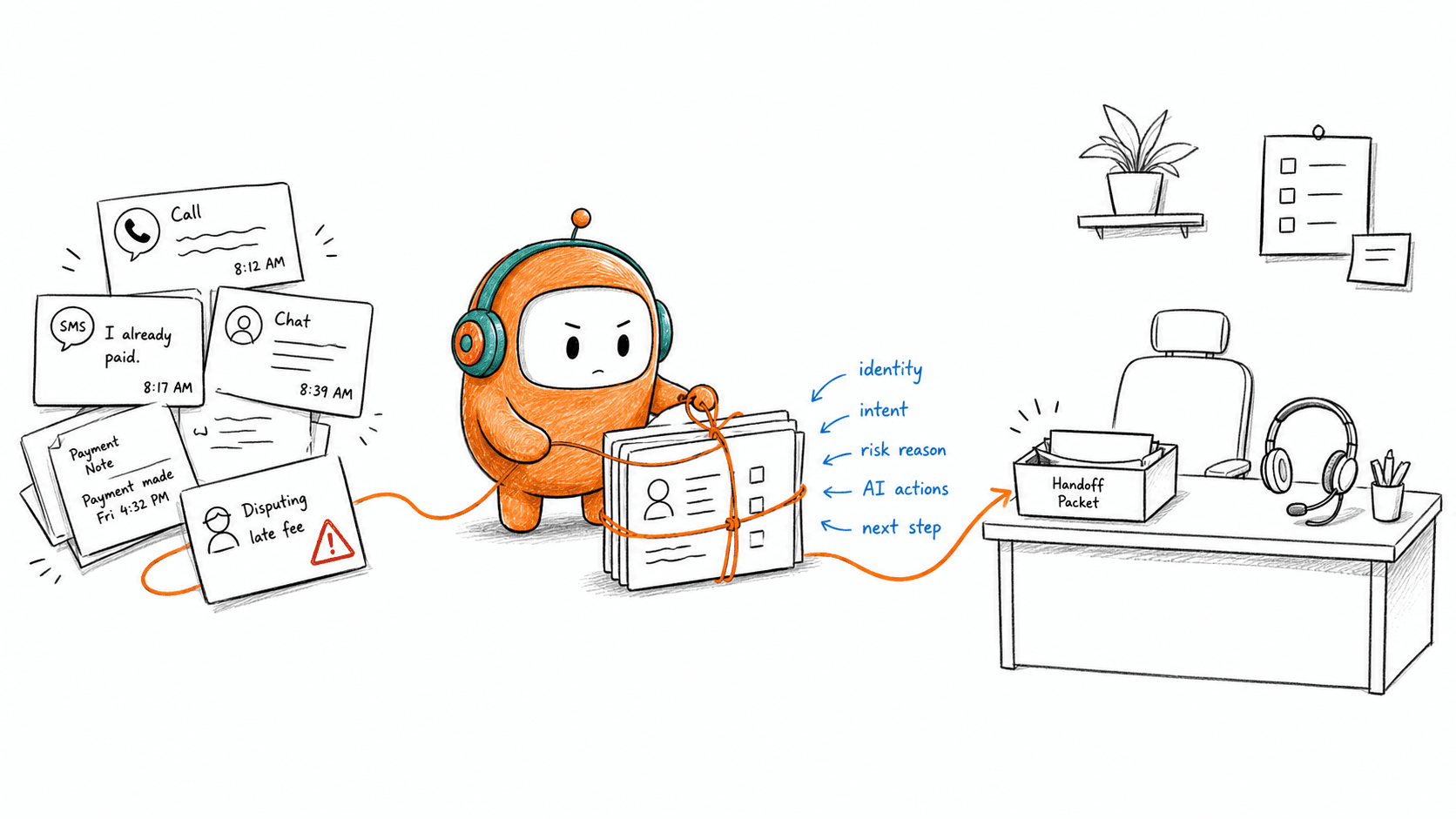
A collections supervisor sees it first at 8:47 AM Monday. One customer was contacted by an outbound workflow Friday afternoon, replied by SMS over the weekend, called the support line at 8:12 AM, and then opened a chat at 8:39 AM asking why the account still shows past due. Four systems have part of the answer. No one has the full story. The human agent opens with, "Can you explain what happened?" and the customer hears, "We didn't listen."
The handoff is treated like routing, not judgment
Routing sends a conversation somewhere. Judgment decides whether automation should continue at all. Finance workflows need the second one, because the same customer sentence can mean three different things depending on the account state, channel, and prior touch.
"I already paid" is not just a message. In collections, it can be a payment confirmation issue, a dispute, a fraud concern, a data sync lag, or a customer who misunderstood the due date. If the AI keeps pushing the same approved script, the conversation gets worse. If it escalates without context, the human agent has to rebuild the case from scratch.
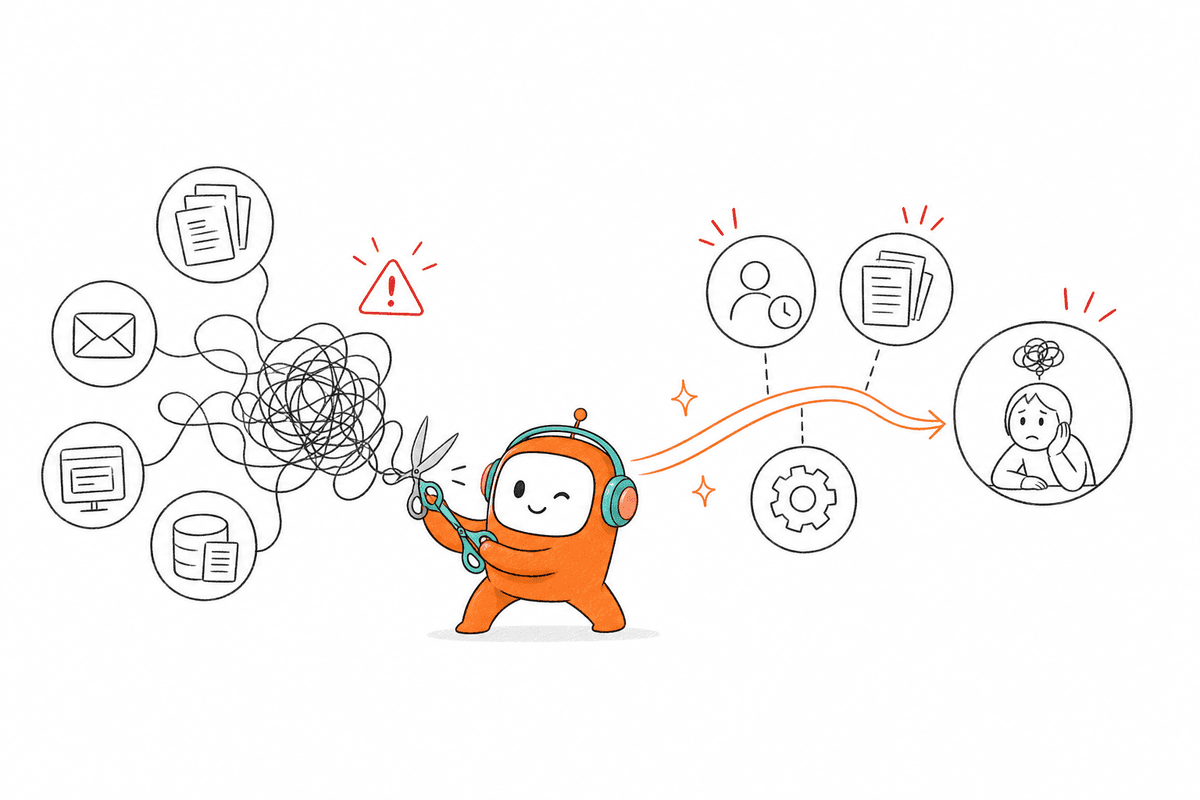
The mistake is easy to understand. Contact center stacks were built around queues, not shared work. AI gets added as a voice bot, chat widget, or outbound layer beside the real system, so escalation becomes a transfer between tools instead of a continuation of work. Honestly, that is where many AI deployments lose trust: not in the answer, but in the awkward moment after the answer stops being enough.
Fragmented tools create false confidence
A finance team can look automated while still being manual underneath. Ticketing lives in one tool. Outbound calling sits in another. Chat has its own transcript. The knowledge base gets updated after policy changes, but the outbound script might lag behind by a week. Finance teams roll through this mess every day, and the dashboard often hides the real cost.
The visible metric says deflection improved. The hidden metric says human agents are spending the first two minutes of every escalated conversation reading, searching, and asking the customer to repeat themselves. If 500 conversations escalate in a week and each one costs two minutes of context recovery, that is more than 16 hours of rework before any real resolution begins. Not dramatic. Still painful.
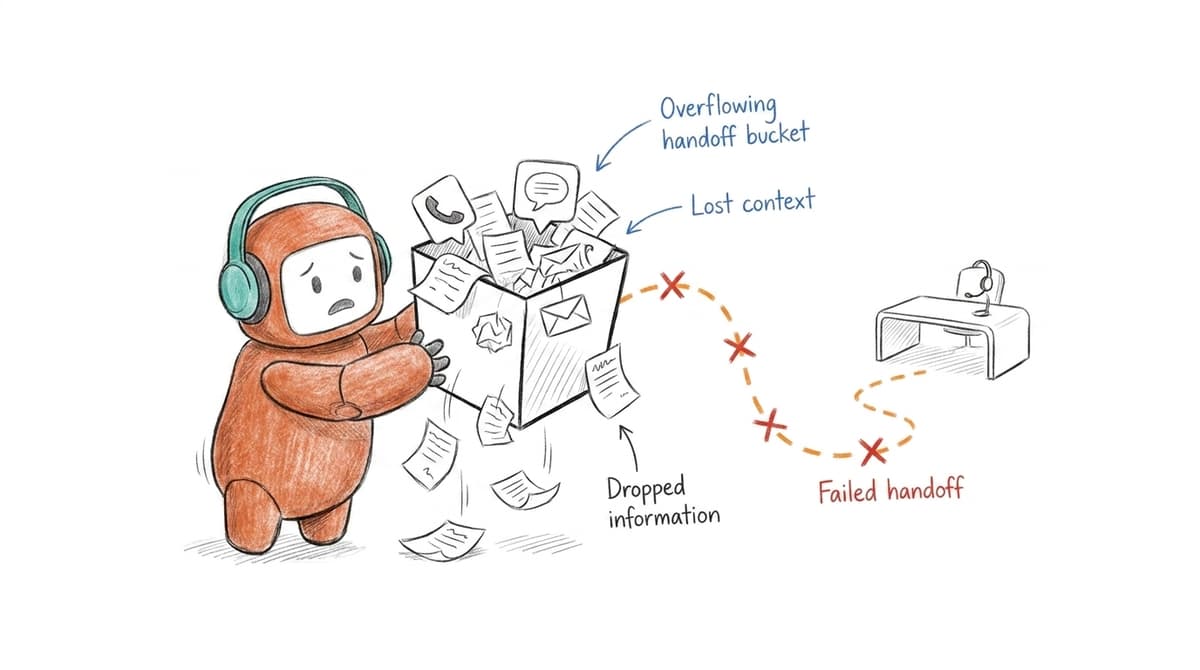
A fair counterpoint: separate systems can work for small teams with simple volume. If you have one channel, one queue, and low-risk conversations, a basic bot plus human inbox may be enough. Finance customer operations rarely stay that simple. Once you add voice, SMS, payment questions, disputes, lead follow-up, collections, and compliance review, the old stack starts acting like a bad relay race where every runner drops a little context. The baton arrives at the human agent without half the information the customer already shared.
The next question is not whether AI can answer more questions. It is whether your operation can tell the AI when to stop.
How Finance Teams Roll With Human Escalation Rules
Finance teams roll with safer AI when escalation rules are designed before automation volume rises. The strongest approach starts by defining which conversations AI may finish, which ones require approval, and which ones should move to a human immediately. Without those rules, every channel becomes a judgment call made too late.
Diagnose handoff quality before changing the AI
Before you touch the model, audit what your human agents actually receive. A clean escalation should be understandable in 30 seconds or less. If the human agent needs longer than that to know who the customer is, what happened, what the AI did, and what should happen next, the issue is not agent training. The handoff packet is incomplete.
Pull 20 escalated conversations from the last two weeks. Pick a mix of voice, chat, SMS, and outbound replies if you have them. Read only what the human agent received at the moment of handoff, not the full transcript later. Then ask a blunt question: could a new agent take the next correct action without asking the customer to restart?
Score each handoff against five checks:
- Customer identity is clear: The agent knows who the person is and which account or case the conversation concerns.
- Intent is stated in plain language: The handoff says "disputing late fee," not just "billing question."
- AI actions are visible: The agent can see what the AI asked, answered, promised, or failed to resolve.
- Risk reason is named: The trigger explains why the conversation moved to a person.
- Next step is suggested: The agent receives the likely action, not only the transcript.
If fewer than 16 of 20 handoffs pass all five checks, do not expand automation yet. Fix the handoff first. We have seen teams obsess over voice quality while agents are still receiving thin escalations that say almost nothing. That order is backwards.
Set trigger rules by risk, not channel
Voice does not automatically mean high risk. Chat does not automatically mean low risk. A customer asking for branch hours on a phone call is simpler than a WhatsApp message disputing a payment plan. Finance escalation rules should follow the nature of the conversation, not the channel where it started.
Start with four trigger groups: financial risk, emotional risk, policy risk, and workflow risk. Financial risk includes payment disputes, balance confusion, refund questions, or anything where the customer may make a money decision based on the answer. Emotional risk includes anger, repeated frustration, hardship language, or signs that the customer is losing trust. Policy risk includes topics where approved language matters. Workflow risk includes cases where the AI cannot complete the next action, such as updating a record, routing to a specialist, or confirming a status from another system.
A practical threshold works better than vague intent labels. Escalate when the customer repeats the same unresolved intent twice, when negative sentiment appears in two consecutive turns, when the conversation passes six turns without resolution, or when the customer uses dispute words tied to payment, identity, denial, or consent. Some teams prefer looser thresholds to keep automation coverage high, and that is a reasonable tradeoff in lower-risk workflows. In finance, I would rather lose a few automated resolutions than let one sensitive case loop too long.
The rule is simple: if the cost of a wrong answer is higher than the cost of a human review, escalate. Finance teams roll safely when that rule is written into the workflow before volume hits.
Give agents the context they would ask for first
The first human response after escalation should never be a discovery interview. Customers can forgive automation that hands off. They rarely forgive being forced to repeat the entire story after the handoff.
Build the escalation summary around the questions a strong agent would ask in the first 20 seconds. Who is the customer? What did they want? What did the AI already say? What policy, account state, or campaign step matters? What is the safest next action? If those answers are missing, the agent is not receiving a handoff. They are receiving a puzzle.
For finance workflows, the summary should include:
- Customer state: applicant, active customer, past-due account, disputed account, or returning lead.
- Channel path: where the conversation started and any channel changes.
- Trigger reason: sentiment, unresolved intent, compliance rule, payment dispute, or custom rule.
- Conversation summary: short enough to scan, specific enough to act.
- Suggested next step: route, review, call back, approve message, collect more information, or close.
There is a catch. Too much context can slow agents down. A full transcript is useful for review, but not as the main handoff view. Put the summary first and the transcript behind it. If your agents have to scroll through 40 turns to find the moment that matters, your escalation design is making them work like investigators instead of operators.
Keep operations in control of rule changes
Finance workflows change more often than engineering teams can reasonably support. Collection scripts change. Qualification criteria change. Review thresholds change. A regulator, risk lead, or business owner asks for a new approval path, and suddenly yesterday's automation logic is no longer acceptable.
That is why no-code configuration matters. Not because operations teams should own every technical layer. They should not. IT still needs to handle integrations, infrastructure, permissions, and data movement. Day-to-day workflow rules, however, should not require a ticket, a sprint, and a vendor call every time a script, escalation trigger, routing rule, or tone setting needs adjustment.
Use a simple ownership split:
- Engineering owns system connections: APIs, webhooks, data sync, security, and deployment constraints.
- Operations owns workflow behavior: scripts, escalation paths, campaign steps, approval rules, and routing logic.
- Compliance owns policy boundaries: consent rules, contact windows, opt-out handling, and required review steps.
- Supervisors own feedback loops: scoring, corrections, knowledge gaps, and agent coaching.
If one group owns all four, change slows down. If no one owns them, risk increases. Finance teams roll better when responsibility is split cleanly, because the work moves without turning every policy update into a software project. For teams already seeing escalation rules outgrow their current stack, the next useful step is to book a demo and walk through a real handoff path from AI to human.
Price outbound by reached customers, not failed attempts
Outbound finance work has a billing problem that product demos often skip. Failed connections are common. Customers miss calls, numbers change, voicemails pick up, and some outreach windows are narrow. If your pricing model treats every attempt like a successful reach, your cost curve starts to punish the very workflows that need careful follow-up.
A better finance model separates attempts from reached customers. The commercial unit should match business value: actual contact, not dialer activity. This matters for collections, re-engagement, reminders, and lead follow-up because the operation is trying to reach the right person with the right message, not generate the most call attempts.
Use this buying test before signing any outbound AI contract:
- If pricing is per minute, ask how long failed calls, voicemails, and abandoned calls are billed.
- If pricing is per attempt, model your cost at 30%, 50%, and 70% failed connection rates.
- If pricing is per conversation, define exactly when a conversation starts.
- If pricing is per reached customer, confirm whether repeat touches to the same customer in the same month are counted again.
The finance team should sit in that pricing review, not only the operations buyer. Procurement may focus on unit cost, but finance understands exposure. If failed attempts count the same as reached customers, the vendor has shifted delivery risk back to you.
Build a review loop that improves the rules
Escalation quality should be reviewed weekly for the first month and monthly after the workflow stabilizes. The goal is not to punish the AI for every miss. It is to find the patterns that tell you which triggers, scripts, knowledge articles, or routing paths need adjustment.
Pick 30 escalated conversations and sort them into four buckets: correct escalation, late escalation, unnecessary escalation, and poor handoff. Correct escalation means the AI stopped at the right moment. Late escalation means the customer had to push too hard before a human joined. Unnecessary escalation means the AI could have finished safely. Poor handoff means the escalation was right, but the agent lacked enough context.
Each bucket creates a different action. Late escalation means tighten triggers. Unnecessary escalation means adjust the boundary or improve knowledge. Poor handoff means change the summary format. Correct escalation should not be ignored either, because it gives you the pattern to repeat.
One production voice deployment at a Vietnamese bank reached 75% auto-resolution in its scoped voice use case after replacing a script-based incumbent. That number should not be treated as a universal benchmark. The useful lesson is more specific: automation worked because the deployment fit the workflow, language, operating controls, and escalation model. Finance teams roll on details like that, not on generic AI claims.
The strongest escalation systems don't try to remove humans. They make human judgment arrive earlier, with better context, and less customer fatigue.
How Revve Keeps Escalations Inside One Workspace
Revve keeps escalation inside the same customer operations layer where AI and human agents already work. The handoff is not a jump from bot to separate queue. It carries conversation history, trigger context, summaries, and suggested next steps into the human workspace so the agent can continue without restarting.
One workspace for AI and human agents
Revve gives AI agents and human agents a shared workspace across inbound support and outbound engagement. Conversations from voice, chat, SMS, WhatsApp, email, Messenger, Zalo, web chat, app chat, LINE, Instagram, and LinkedIn can stay tied to one customer thread, depending on the configured channels. That matters because finance escalation is rarely single-channel. A customer may ignore a call, reply by SMS, and then use chat to dispute the same issue.
Smart Escalation and Full-Context Handoff is the feature that turns the methodology above into daily operations. Revve can monitor active conversations against configured triggers such as negative sentiment, unresolved intent, keywords, conversation duration, or custom rules. When the threshold is met, the conversation moves to a human with the full thread, summary, prior history, relevant context, and AI-suggested next steps.
The important boundary is human control. Revve does not imply every escalation is automatic or that humans disappear from the process. Teams define the criteria, approval rules, and workflows. In finance, that distinction matters because automation should support judgment, not pretend judgment is no longer needed.
No-code changes without removing governance
Revve provides no-code configuration, testing, and rollbacks so operations teams can adjust scripts, workflows, routing, tone, and scenarios without sending every daily change to engineering. Before publication, teams can preview changes, run payload checks, and test batches against expected scenarios. That gives operations speed without turning sensitive finance workflows into guesswork.
Compliance Controls and Approval Workflows add another layer for outbound and sensitive messages. Revve can check configured rules such as consent status, local time windows, do-not-call restrictions, and opt-out requirements before contact or delivery. It gives the operation a governed place to apply the rules the business has already defined.
Make Escalation a Workflow, Not a Rescue
Finance teams should treat escalation as part of the workflow, not a backup plan for when AI fails. The question is not whether automation can handle more volume. It is whether automation can stop at the right moment, pass the right context, and let a human continue without making the customer start over.
If your current handoffs require agents to search three tools, reread long transcripts, or ask customers to repeat sensitive details, the AI is not the only problem. The operating layer is broken. Fix that layer, and human escalation stops feeling like a rescue mission. It becomes the normal way finance teams roll when judgment matters.