Your support team can clear 400 tickets before lunch and still miss the revenue follow-up that mattered. That's why regulated teams still choose customer operations platforms that connect inbound support with outbound engagement, not support bots that stop at deflection. The real cost shows up in the handoff: a customer asks for help, qualifies for follow-up, needs a reminder, then disappears between the queue and the next team.
The strange part is that most regulated CX stacks look mature from the outside. Helpdesk in place, voice vendor approved, chatbot launched, SMS vendor contracted, reporting wired into BI. Then a customer asks one question in chat, misses a payment reminder by SMS, calls the next morning, and the human agent has to rebuild the whole story from scattered notes.
The problem isn't that regulated teams are afraid of AI. Honestly, I don't think that's true anymore. The problem is that they don't trust AI when it sits outside the real customer operation, answering questions in one tool while follow-up, escalation, routing, and approval happen somewhere else.
Key Takeaways:
- Regulated teams still choose unified customer operations platforms because control matters as much as automation.
- Inbound-only AI misses a major part of the job: outreach, reminders, qualification, collections, and recovery.
- The real risk isn't AI answering badly once. It's disconnected systems creating inconsistent handoffs every day.
- A better CX stack starts with shared context, shared knowledge, and clear human handoff rules.
- Operations teams need workflows they can change without waiting weeks for vendor or engineering updates.
Why Regulated CX Stacks Break When AI Sits Outside the Workflow

Inbound AI Only Solves Half the Job
A support team can deflect 40% of routine questions and still lose customers because follow-up never happens. That sounds harsh, but it's the part many AI support pitches skip. Customers don't only contact you when they need help. They also need reminders, appointment confirmations, payment follow-up, re-engagement, sales callbacks, and recovery after they drop out of a process.
For a Head of CX, that creates a strange reporting problem. Ticket cost may improve while customer outcomes stay flat. The inbound queue looks healthier, yet revenue teams are still chasing stale leads, collections teams are still calling from another system, and agents still don't know what happened before the customer arrived. In my view, that's why regulated teams still choose platforms that cover both sides of the conversation lifecycle, not just the support inbox.
Fragmented Tools Create Compliance Drift
Compliance drift starts when every channel has its own rules, logs, scripts, and owner. A support agent may see the latest approved answer in the helpdesk, while an outbound team runs an older message from a dialer, and the chatbot pulls from a FAQ that nobody updated after the policy meeting. Each tool may be defensible on its own. Together, they create a control problem.
Picture a CX manager reviewing a complaint at 4:40 PM on a Thursday. The customer first came through web chat at 9:12 AM, then received an SMS reminder at 11:03, then called support at 2:47, then got escalated to a supervisor twenty minutes later. Four systems, three timestamps, and two slightly different answers about the same refund policy. By the time the team reconstructs the trail from Zendesk notes, dialer logs, and a supervisor's Slack thread, the customer is already frustrated and the manager is asking a painful question: did the process fail, or did the stack make failure too easy?
AI Becomes Another Queue
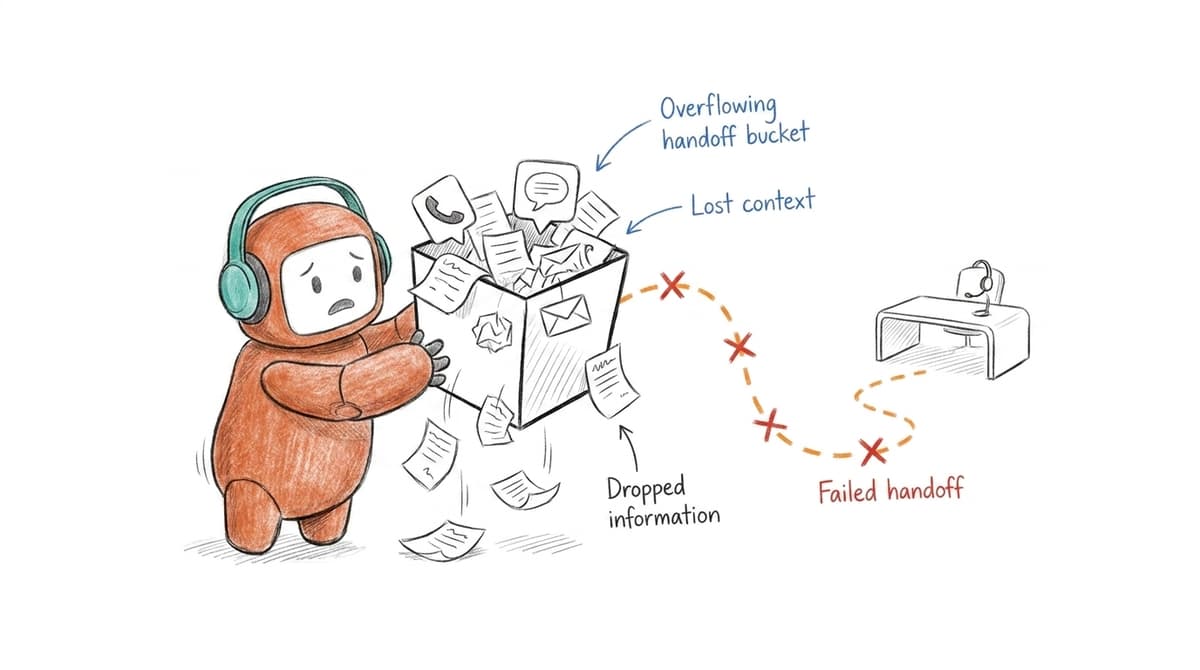
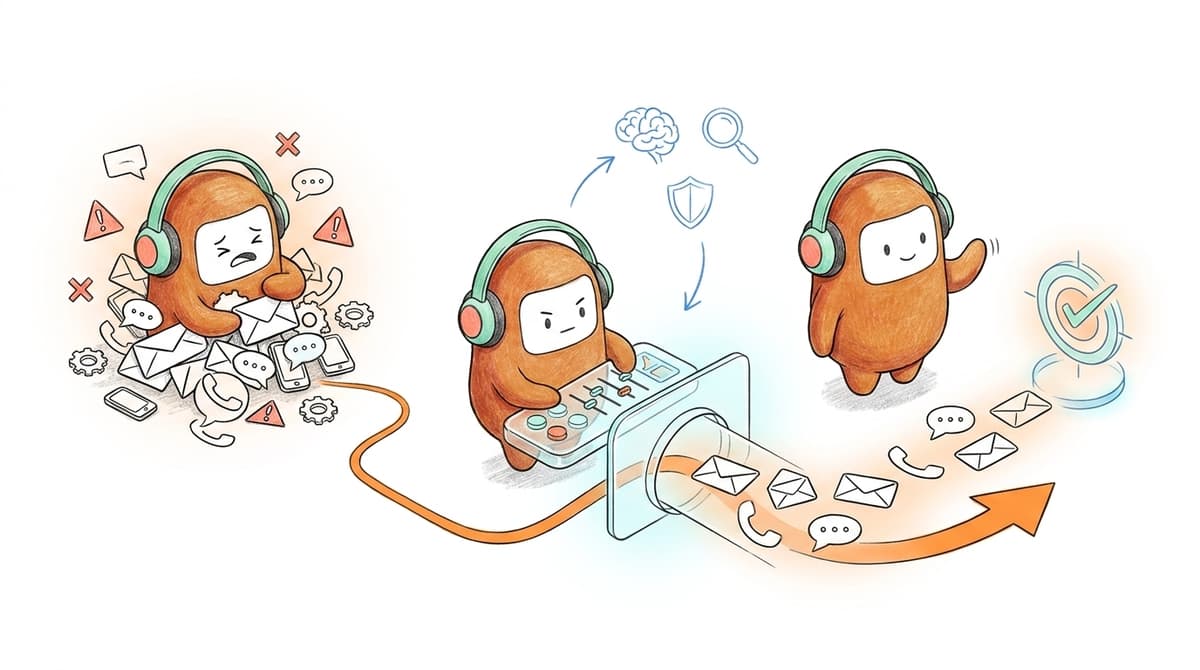
AI should reduce queues, not create one more place for work to hide. When the bot answers in a separate tool, the human agent often receives only the final escalation, not the reasoning, the failed attempts, the prior channel history, or the next action expected. It feels like progress in a dashboard and like a scavenger hunt on the floor.
The better mental model is a control room, not a chatbot window. In a control room, every signal feeds the same operating picture: who the customer is, what they asked, what they were promised, what rule applies, and who needs to act next. Without that shared picture, regulated CX leaders aren't really managing automation. They're managing gaps.
How Regulated Teams Choose AI Without Losing Operational Control
Regulated teams choose AI safely by judging the operating model before judging the model demo. The right test is simple: can the system answer, route, log, follow up, escalate, and preserve context across inbound and outbound work? If not, it's only handling a slice of customer operations.
Start With the Handoff, Not the Bot
Audit the last 20 escalations from AI to a human agent before you audit anything else. Don't start with accuracy scores. Start with what the agent actually received. If the agent had to ask the customer to repeat the issue, open another tool, search a CRM note, or guess what the AI already tried, the automation didn't hand off. It abandoned the conversation.
A useful review has three questions. Did the AI capture the customer's intent and prior answers? Did the human agent receive enough context to continue without restarting? Did the next workflow step happen in the same operating layer, or did someone copy the issue into another queue? If two of those three fail, buying a smarter bot won't fix the real problem. If all three fail, the automation is actively adding friction, and pausing the deployment is cheaper than defending it.
Some teams prefer a narrow support bot because it's easier to approve. That's valid for a contained FAQ use case with fewer than 50 approved answers and no outbound dependency. The limitation shows up when regulated teams still choose a broader platform later because the narrow bot can't manage follow-up, approvals, outbound, or cross-channel history without another round of stitching.
Treat Outbound as Customer Operations, Not a Side Campaign
Outbound used to sit outside CX. Sales owned follow-up, Finance owned collections, Support owned inbound, Marketing owned campaigns. Customers never cared about that org chart, and regulated teams pay for the gap when one department contacts a customer without seeing what another department already promised.
A better operating rule is simple: if the outreach changes the customer relationship, it belongs in customer operations. Lead qualification, payment reminders, appointment confirmations, document follow-up, renewal nudges, and re-engagement all need the same context as inbound support. They also need the same governance: contact rules, opt-out handling, approved scripts, routing, escalation, and audit trails.
For US enterprise teams, EagleView is a useful market-lane example because the need was outbound lead engagement tied to sales motion, not generic support deflection. The lesson isn't "automate every call." The lesson is that outbound becomes much more credible when it connects to qualification, handoff, and follow-up instead of running as a separate dialer campaign.
Build the Knowledge Layer Once
A knowledge base nobody updates is worse than no knowledge base because it creates false confidence. Agents trust it, AI trusts it, customers hear the output. Then a policy changes, an edge case appears, and the operation discovers that each channel has been learning from a different source.
The fix is not to write more FAQs. Start by separating knowledge into three buckets:
- Approved answers: content AI can use directly in customer conversations.
- Agent guidance: internal notes that help humans make judgment calls.
- Workflow rules: routing, escalation, eligibility, timing, and next actions.
That split matters because regulated CX work is not only about saying the right words. It is about taking the right action after the words. A refund answer, a payment reminder, and a sales qualification step may all use the same customer record, but they need different approval paths and different handoff rules.
Honestly, this is where many AI projects become messy. The demo uses a clean document set. Production uses policy docs, CRM fields, supervisor notes, old macros, regional exceptions, and messages that legal approved six months ago. If regulated teams still choose platforms with shared knowledge, it's because one approved source is easier to govern than five partial ones.
Put Humans Where Judgment Actually Matters
AI should not be judged by how much it replaces people. It should be judged by whether it gives people the right work. A human agent should not spend their day answering "where is my order" if the answer is approved, repeatable, and easy to retrieve. That same agent absolutely should handle the angry customer, the exception request, the unusual account history, and the conversation where empathy changes the outcome.
The practical design is to draw escalation lines before launch. Use simple triggers: negative sentiment, unresolved intent, repeated question, high-value customer, sensitive topic, long conversation, or any keyword that requires review. Then test those triggers against 200 real transcripts before go-live. If you can't explain in one sentence why a conversation stayed with AI or moved to a person, the workflow isn't ready.
Some leaders worry that too many handoff rules will slow the program down. They're not entirely wrong. More controls mean more design work upfront, and the first two weeks of tuning will feel slower than a plain chatbot rollout. The tradeoff is worth it in regulated customer operations because the cost of a bad handoff is not only time. It's customer trust, supervisor review, and sometimes a complaint that should have been prevented.
When your team starts mapping these handoffs, the useful question is not "can AI answer this?" It is "what should happen after the answer?" If that question is still unresolved inside your current stack, book a demo to see how one operating layer can carry the context from answer to action.
Test Change Speed Before You Sign
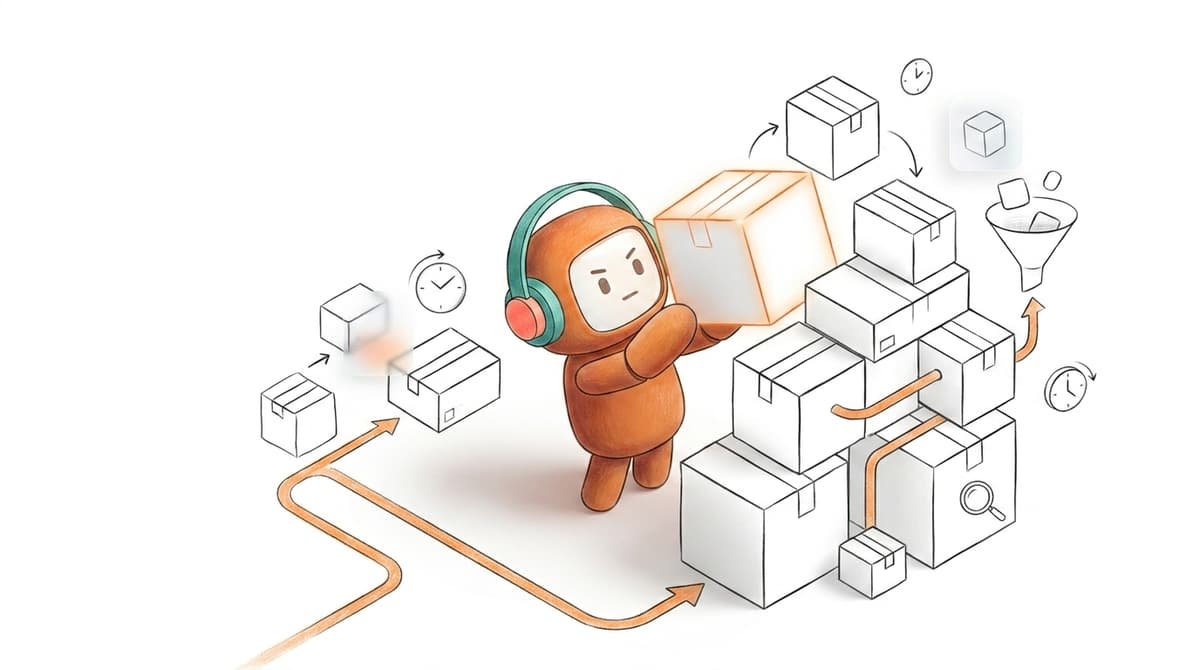
A regulated CX workflow is never finished. Scripts change, campaign timing changes, qualification criteria change, escalation rules change, new product issues appear, and legal asks for a phrase to be revised. Operations learns that a reminder works better after two hours than after 24. The system has to absorb that change without turning every update into a mini implementation project.
Before choosing a platform, ask the vendor to change a live workflow in front of you. Not a fake demo branch. A real operating change: adjust a routing rule, update a script, test an outbound sequence, revise an escalation trigger, and roll back the version. If the answer is "professional services will handle that," you need to know what that means for the next 12 months of CX operations.
A good threshold is 48 hours. If a normal operations change takes longer than two business days after approval, your team will start working around the system. They will create side spreadsheets, side scripts, side queues, side reports. That's how fragmentation comes back through the back door, even after a platform project looks complete.
How Revve Runs Inbound and Outbound in One Workspace
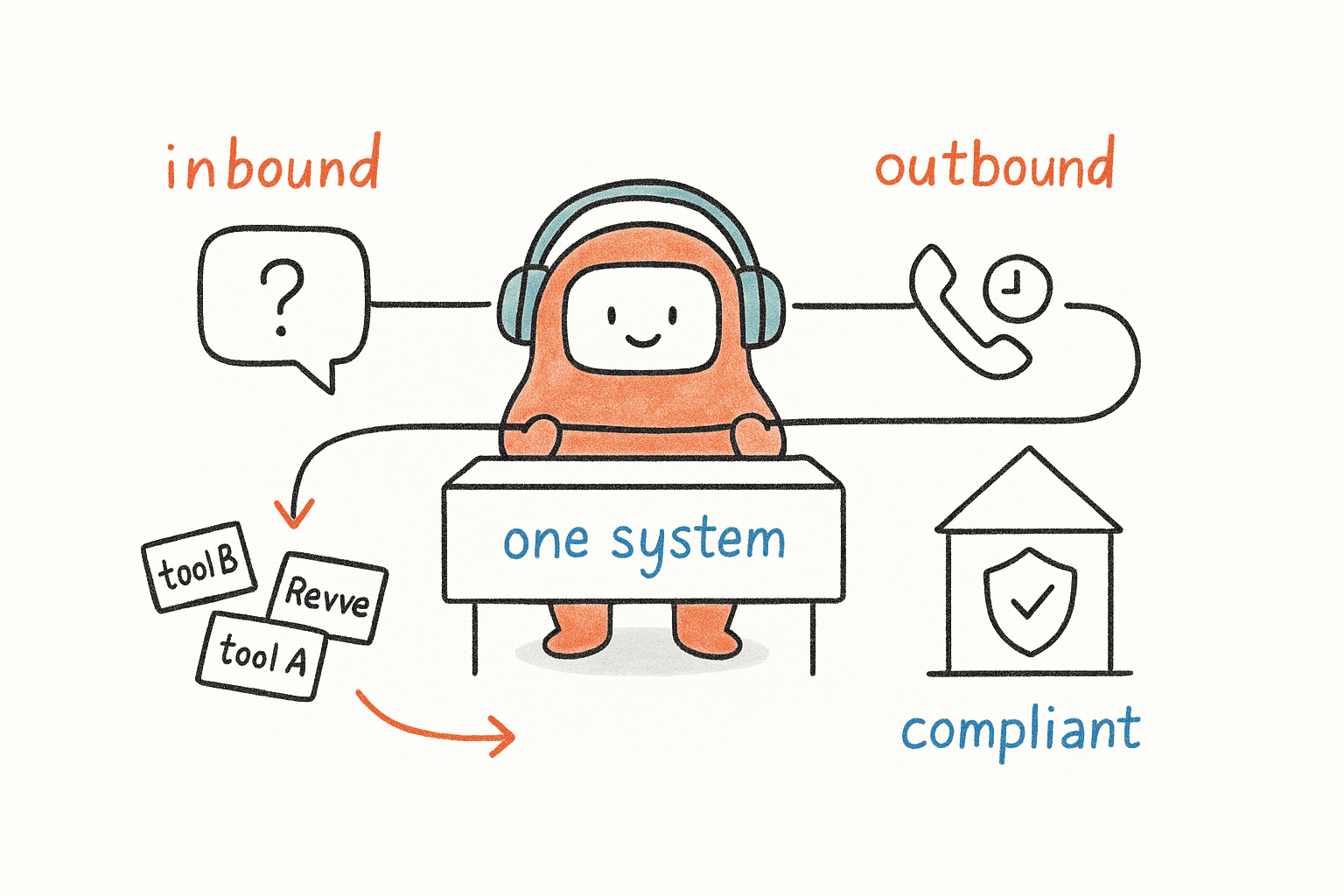
Revve gives regulated CX teams one workspace for AI agents, human agents, inbound support, and outbound engagement. The platform brings voice, chat, SMS, messaging, ticketing, knowledge, routing, and handoff into the same operating layer, so teams can manage automated and human-led conversations in one place instead of across disconnected tools.
One Workspace for Human and AI Agents
Revve is not a chatbot sitting beside your helpdesk. Revve is built as a customer operations platform where AI agents and human agents work from the same conversation record. When AI handles an interaction, the activity is logged in the shared workspace. When a person needs to step in, the agent receives the prior thread, context, and suggested next action instead of starting cold.
That matters for regulated teams because handoff is where many automation programs fail. Revve's unified AI and human workspace, omnichannel inbox, and smart escalation model are designed around continuity: the customer can move from chat to voice to SMS follow-up without forcing the internal team to rebuild the story. For a Head of CX, that means fewer tabs, fewer context gaps, and cleaner oversight across the work.
Revve also keeps outbound inside the same operating model. Lead qualification, reminders, collections, and campaign outreach can run alongside inbound support rather than living in a separate dialer or messaging tool. The value is simple: customer operations can see both what customers ask for and what the business needs to follow up on.
Governance, Configuration, and Deployment Control
Revve supports compliance-aware workflows through configurable controls for consent status, contact windows, opt-out handling, approvals, and message review. Revve does not remove your legal responsibility, and it shouldn't be positioned that way. Your team still owns policy, consent, disclosure, and review. The platform's job is to make those rules easier to apply inside the actual workflow.
Operations teams can also adjust scripts, routing, tone, scenarios, and outbound sequences through no-code configuration, with testing and rollback options before changes go live. That's a big operational difference. A CX team shouldn't need to wait weeks every time a qualification question changes or a support escalation rule needs tightening.
Revve supports both cloud and on-prem deployment models for teams that need flexibility around security, infrastructure, or regulatory requirements.
The Customer Operations Stack Needs One Work Layer
Regulated teams still choose customer operations platforms because fragmented AI creates fragmented accountability. A bot that answers support questions is useful. A system that connects answers, routing, follow-up, escalation, knowledge, and outbound is much closer to how CX work actually runs.
Revve is built for that second model. It does not replace your CRM, your legal team, your BI stack, or every human agent. It gives customer operations one place to run the conversation work across inbound and outbound, with humans and AI sharing the same context. Innovation only matters when the workflow can carry it.